Sometime before fall quarter begins a new sculpture will sprout on the Parrington Lawn just south of the new law school. A large, free-form piece made of stainless steel, it actually has a title that fits right in with its academic setting.
鈥淚 call it The Department of Forensic Morphology Annex,鈥� said sculptor Cris Bruch. 鈥淚t鈥檚 a field whose time will come and when it does they鈥檒l want to build a building. But they鈥檒l have to start in an annex.鈥�
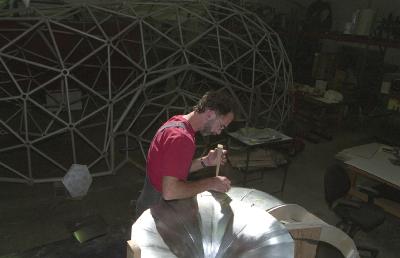
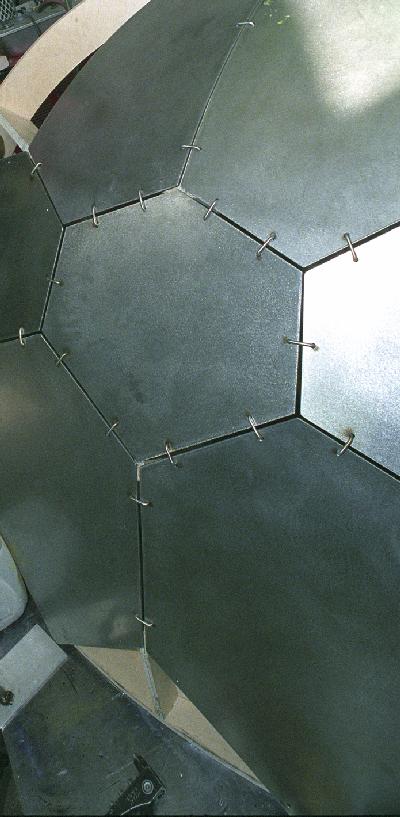
The title is emblematic of Bruch鈥檚 dry wit, but the sculpture is no joke. Thanks to an exterior that consists of dozens of irregular shapes individually welded onto a base, building it has been a laborious process consuming many months.
The sculpture鈥檚 underlying structure is a geodesic dome of sorts 鈥� tubular pieces connected up in triangles that together form not a dome, exactly, but a variant of it. The 鈥渟kin鈥� on the outside of that structure is separated from it by about 3 inches and fastened with pins that are about a half-inch in diameter and welded on. Because the overall shape of the underlying structure is not a standard one, the pieces of steel that cover it have to be individually measured and cut to fit as the fabricators build it.
鈥淭hat鈥檚 unusual in public art,鈥� said Kurt Kiefer, campus art administrator. 鈥淯sually, everything is figured out in advance, but with this sculpture it had to be done one piece at a time.鈥�
The work-in-progress currently resides at Fabrication Specialties, Ltd., a 糖心少女alumni-owned art fabrication company in South Seattle, where Bruch is working with employees to complete the sculpture before moving it to the campus by truck.
鈥淚鈥檝e never built anything like this, but I think it is recognizable as my work,鈥� Bruch said. 鈥淚 often use a lot of parts and a really intensive process and I鈥檓 very interested in different kinds of strength.鈥�
Bruch said he spent a lot of time scrutinizing the site and that what he was going for was a 鈥渉idden in plain sight鈥� kind of work.
鈥淚 wanted to make connections to both the wind tunnel and the observatory,鈥� he explained. 鈥淭hey鈥檙e right out in the open but a lot of people don鈥檛 see them. Or they鈥檝e seen them so repeatedly that they鈥檝e forgotten they鈥檙e there. That鈥檚 always a very interesting thing to me experientially.鈥�
Besides its resemblance to a geodesic dome, the sculpture also calls to mind an igloo, or even a dog lying on its side. Bruch calls it 鈥渁n animated, mechanical form.鈥� He hopes people will be fooled by the scale 鈥� seeing it as either bigger or small than it is. The actual measurements are 23 feet long, 9 feet wide and 8 feet tall.
Kiefer said the skin will have a variety of surface finishes. 鈥淪ome of the pieces will have this sort of swirly matte-type finish and a few places will be polished shiny,鈥� he said. 鈥淎nd there are gaps in the skin so you鈥檒l be able to see inside. What I鈥檓 looking forward to is when the sun is setting and you鈥檙e standing on the east side of the sculpture, you鈥檒l be able to look and see sun coming through it.鈥�
The sculpture is funded by the state鈥檚 half-percent for art program. On campus, that means that one-half percent of any state money given for construction is pooled and used wherever appropriate, so a piece of art is not necessarily connected to a particular building. In the case of Bruch鈥檚 sculpture, Kiefer said the intent was to enhance the 42nd street entrance to the campus.
Bruch called it a 鈥渄ream commission,鈥� saying that once he was selected he wasn鈥檛 given a long list of instructions. 鈥淚鈥檝e been given a huge amount of flexibility,鈥� he said.
Kiefer said a dedication of the sculpture will be held sometime in fall quarter.