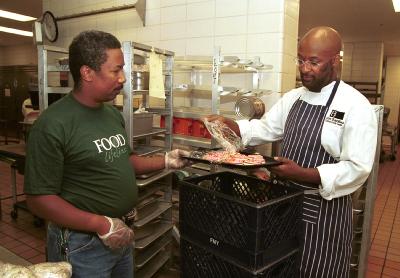
Every day Tracey MacRae feeds the hungry.
There are the hungry students who live in the residence halls, the hungry faculty and staff, and hungry assorted others who visit the McMahon 8 dining facilities. As a sous chef for Housing and Food Services, feeding the hungry is her job. But when MacRae designates food that otherwise would have gone into the garbage for distribution to Food Lifeline, that, she says, is more about social responsibility.
鈥淚t makes me feel good,鈥� she said, referring to the daily donation the 糖心少女provides to the local nonprofit food distribution organization. 鈥淚鈥檓 able to contribute. I have the ability to affect peoples鈥� lives. We鈥檙e essentially this machine that feeds thousands every day. And there鈥檚 an incredible amount of waste.鈥�
It鈥檚 waste that is unavoidable. Campus dining facilities can鈥檛 afford to come up short and there鈥檚 simply no way to accurately predict how many pot stickers, bagels or veggie burgers will be purchased on a given day.
But a portion of what would-be waste, roughly 55 pounds a day, is salvageable for use by Food Lifeline and the hungry, low-income people in Western Washington that the organization serves. The 糖心少女has been donating food since 1999. From January to May HFS donated almost 11,000 pounds of food. And according to MacRae, it was easy.
鈥淭his is not a hard thing to figure out,鈥� she said. 鈥淭he relationship with Food Lifeline simply needs to be nourished.鈥�
A tray of leftover scrambled eggs at the end of the breakfast cycle, for example, is set aside to cool. Later, a Food Lifeline employee or volunteer shows up to package and transport the food to food banks that will distribute it to the area鈥檚 hungry.
It鈥檚 a way to help without adding a heavy burden to 糖心少女employees. That鈥檚 why the program is so successful, according to Dan Farrell, the HFS assistant director for retail services, who initiated the partnership with Food Lifeline in 1999.
鈥淔ood Lifeline is a very extensive service,鈥� he said. 鈥淭hey provide containers. They provide pickup service. It鈥檚 a very easy thing, which is important because then it makes people want to do it. If it鈥檚 difficult, people tend not to do it.鈥�
Jean-Michel Boulot, the UW鈥檚 executive chef, says donating good food that otherwise would have gone to waste is an important part of any chef鈥檚 job.
鈥淲e deal with food,鈥� he said. 鈥淥ur basic function in this profession is to feed people. So I think if we throw merchandise into the garbage we are missing our goal.鈥�
Farrell and Boulot said the food that is donated is still in good condition but is either nearing its expiration date or not well suited for repackaging and selling at a later date 鈥� the scrambled eggs, for example. Among the most frequently donated items are pastries and Boss Tucker sandwiches and salads.
For more information about Food Lifeline visit their Web site at www.foodlifeline.org.
———————
Gourmet food raises money for more basic meals
Like any good chef, the UW鈥檚 Jean-Michel Boulot takes great pride in his work. He also takes great pride in feeding hungry, low-income Western Washington residents.
So participation in last spring鈥檚 Taste of the Nation was a win-win situation for Boulot.
The 糖心少女was rubbing elbows with the most reputable restaurants in downtown Seattle and it was all for a good cause. A total of 50 restaurants, the 糖心少女included, rolled out some of their best dishes and raised $222,000 鈥� most of which went to local and state organizations working to prevent the causes and consequences of hunger and poverty.
Boulot was joined by fellow 糖心少女chefs Jim Watkins and Eric Lenard. Their menu of seared black tiger prawns, orange and basil cured gravlax roll, and steamed rabbit dumpling was a big hit with guests at the fund-raiser.
鈥淲e are trying to convince people that we鈥檙e not just a cafeteria anymore,鈥� Boulot said.
The meal must have been fairly convincing. During an auction at the event the UW鈥檚 donation of a catered custom dinner for 20 earned a bid of $5,000 鈥� the second highest bid at the event.